Planets
Orbits
Orbits Explained
Celestial Mechanics
ORBITS EXPLAINED
Welcome fellow planetary enthusiasts!
Presenting
a manuscript in celestial
mechanics based on a
new mathematical
device:
The Hododyne
The proof for the hododyne is in Chapters 8 and 9 of Orbits
Explained.
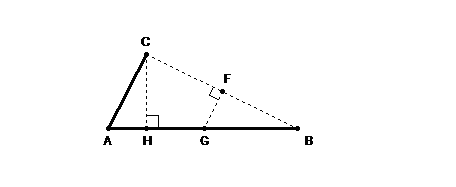
 Then, in Chapters 5 and 11, since radius is
inversely proportional to tangential velocity, we assign AG to
be the radius and HB  to be  the tangential velocity.  As AB
spins around AC, G traces the orbit of the planet - an ellipse.  
A priori.
For a quick version of the
proofs in Orbits Explained click
here.
It seems that existing proofs of Kepler's Laws
including Lagrangian and Hamiltonian methods,
based on potential and kinetic energy and the  
conservation of energy and momentum, might
require the assumption of the inverse square law of
force at some step in their derivations.  Hence this
attempt at a more a priori method of explaining
orbits.
-D.S. Marlin
Editor's Note
The classical question regarding the shape of planetary orbits and the nature of the attractive force toward the Sun
has been answered.  The ability to provide an answer has historically depended on assuming either that orbits are
elliptical or that the force is the inverse square of distance to the Sun.  Johannes Kepler proved the premise that
orbits are elliptical using astronomical observations.  Isaac Newton subsequently proved that force must be inversely
related to the square of the distance using Kepler's proof that obits are elliptical.  Conversely it can be proven that
orbits are elliptical if the Inverse Square Law of force and distance is the premise.  But heretofore, it has not been
possible to prove the law that orbits are ellipses, or the law of how force varies, without knowing either law.   
Is it possible to prove both laws using only the laws of inertia?   I say , yes. (Newton's Law of Inertia states
approximately  that bodies in motion continue along on a linear path at constant velocity unless acted on by external
force.)  Where would one begin?  Is there a method that was not evident to Kepler and Newton and subsequent
mathematicians and astronomers?  I say yes again, and the method is as follows.
Newton showed in his work,
Principia, using simple geometry, that a body in motion subject to an attractive force will
sweep out equal areas in equal times.  We can show furthermore that the distance to the Sun must be inversely
related to tangential velocity in order for equal areas to be swept in equal times.  So, we have two properties that are
inversely related to each other.  All that is required is to find a geometrical way to represent inverse proportions.  I call
this geometrical tool a hododyne.  It turns out that there are only two geometrical possibilities for a hododyne since a
hododyne must portray tangential velocity and radius to the Sun at right angles to each other.  Tangential velocity
can either be parallel or perpendicular to the radius on a hododyne.  Any other arrangement requires adjustments of
angles between radius and tangential velocity, the result being that the mathematical result degenerates back into
one of the two aforementioned hododynes.  When we examine the hododyne wherein the tangential velocity is parallel
to the radius, we find that an elliptical orbit results and that the force varies as the inverse square of distance.  When
we examine the other hododyne wherein the tangential velocity is perpendicular to the radius we find that the orbit is
an ellipse and that the force increases directly with distance as per Hooke's Law for masses on springs.
We can rule out the second hododyne and hence its force law as follows.   If force were to increase with distance, all
matter in the universe would collect at a single point.  In a sense the universe would be collapsed.  Since this is not
the case, we can rule out this force law.  Thus, the only valid hododyne for planetary motion is therefore the one that
represents elliptical orbits and the inverse square relationship of force and distance.
The mathematical proofs of the hododynes and the a priori proofs of the planetary laws are presented in the
chapters of the text,
Orbits Explained.  Please see the acknowledgements in the text.  
Welcome and best wishes, - David S. Marlin
Welcome teachers
Welcome students
Welcome readers
Welcome scientists
Welcome all
Original and traditional
material included.
How is this site unique?
Orbits Explained is perhaps the first a priori set of proofs for Kepler's Planetary Laws.  
Existing proofs require either the Inverse Square Law of Gravitational Force or the Law
of Ellipses for Planetary Orbits.  
Orbits Explained relies instead upon a new and original
mathematical device, the hododyne.   All the proofs involve gentle mathematics and logic.

How to use this site:
Click on the link below to access the course chapters.  Each chapter presents a single
topic to be studied in sequence.  Alternatively, try the short overview by following the link
at the top of the page. Teachers and students are welcome to download and print chapters
free of charge.  Comments and corrections are encouraged.
Click here for Course Chapters
or click the link at the top of the
page
Suggestions for
teachers:
The material in Orbits Explained can be used to teach various concepts
in mathematics, physics and philosophy.  These include:
Empirical versus a priori reasoning.
Inverse Proportions.
Geometry.
Algebra.
Trigonometry.
Basic laws of force.
Creative reasoning.
Kepler's Laws.
Newton's Law of Gravitation
A New Reflective
Property of the Ellipse
Introducing a new property of
planetary orbits, the reflective property
of the focus of the elliptical orbit.  For
any position on the ellipse, a line
drawn to the Sun at a focus reflects off
the axis to another point on the ellipse
where the radial velocity of the planet
is identical.  This is evident in the
hodograph determined by the
hododyne.  See if you can verify that
this is true after studying Chapter 18.
In this addendum, we are on a trail blazed by, and
so we honor, Joseph Louis Francois Bertrand
(1822-1900) and others who have examined the
possible central force laws for repetitive orbits.  
Bertrand's tools were higher level math and
brilliance.  Our tools are gentle math and the
hododyne.
Addendum: The
second hododyne of
central force.
Click here for PDF Format of Expanded
Addendum for Central Force
       Diagrams and more complete details are in the two links above, concerning the generalization of a priori methods
in an attempt to include all the possible central force laws.  It will be shown that there are only two possible hodograph
shapes for orbits.  One is circular as determined by the hododyne as descibed in
Orbits Explained and describes the
true movement of planets according to the inverse square law of force.  The other hododgraph shape is elliptical as
occurs in the orbit according to Hooke’s Law for which the force is proportional to the distance from the attracting body
situated at the center of the elliptical orbit, such as for a mass on a spring.  These are the only two possible logical
hodographs for periodic repetitive orbits since their velocity vectors rotate 360 degrees around the central body
without violating basic laws of motion.  As with Plato’s Proof that the square root of 2 is irrational since it can not be an
odd integer divided by an even integer, nor an even divided by odd, nor odd by odd; it will be shown that there are
only three possibilities for central force.  The force can decrease with radius, increase with radius, or be constant
unrelated to radius.  The inverse proportion between tangential velocity and radius can be found geometrically in an
ellipse in the property described by Apollonius – the parallelogram created by  any semidiameter and its
semiconjugate diameter is of constant area.  The ellipse construction method using concentric circles determines the
point of tangency for any position on the ellipse.  Using the tangent direction, radius, and by designating the
semiconjugate diameter to the radius to be total velocity, it becomes evident that the tangential velocity, by virtue of
being inversely proportional to the radius validates the following representation of total velocity.  The total velocity
vectors, as semiconjugate diameters, trace an elliptical hodograph.  The radius as viewed from the center of the
ellipse goes from minimum to maximum and then from maximum to minimum, or vice versa, for each consecutive
quadrant of the ellipse.  By equal areas swept in equal times, the radius sweeps each quadrant in equal times.  As
viewed from the center of the ellipse, the radius therefore increases progressively to a maximum and then to a
minimum in equal times.  We recognize this change in radius to be  simple harmonic motion for which the central
attractive force increases directly with distance from the center of the ellipse.  Such would be the case for a mass on a
spring rotating around a central body.
The central force law just described is incompatible with an expansive Universe filled with galaxies since if the Universe
existed this way, infinite force would attract infinitely distant masses so that the Universe would collapse.  Logically the
only way for this central force law to exist would be for the rigged situations whereby the planet and Sun were
physically connected by material that was elastic.
The possibility of force being unrelated to distance is ruled out by analyzing a theoretical planet in a circular orbit
whose radius increases.  The amount of force to maintain the circular orbit can not be increased and so the planet will
escape.  Only circular orbits could exist.  The required proper matches of central mass, force, and distance would
make orbits a rare occurrence.  Solar systems would be impossible.  Only one planet per Sun would be possible.
And we see in a priori fashion that of our three ranges of possibilities for central force, only two are valid, and among
those possibilities only two force laws are compatible with repetitive orbits.  And of those two, only one makes logical
sense for the Universe.  


This new machine’s design
So aptly rations out a line
That when it regulates the sky
It's called a hododyne
Click on the link below to see
the Editor's Note written by
Joseph J. Marlin
Welcome to a free online course in celestial
mechanics using a new tool, the hododyne.
A Priori
All material copyright 2006 David S. Marlin
Permission granted to copy for study and teaching purposes.